Biography
The path, in the order it unfolded
From the Darkhad valley to my practice room: forty years, three masters, one drum and a great deal of doubt.
The calling
A three-week fever, in February 1989
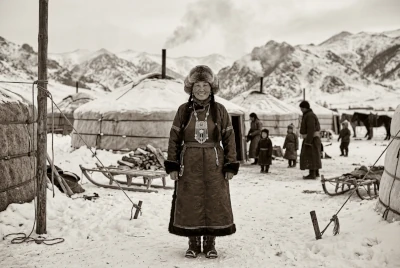
I was eleven. I fell ill on returning from moving the herd, with no cause the Ulaan-Uul clinic could identify. My grandmother Tsendmaa did not argue: she told my parents it was not an illness, but a summons. Among us, this is called ongod orokh — when the spirits knock at a child's door.
My mother resisted for two years. She wanted school in Mörön for me, a job in the city, a life without the drum. I still think she was right, even today: that life is simpler. The fever came back every winter until the apprenticeship began.
Timeline
The stages
A shamanic apprenticeship is not counted in diplomas but in seasons spent with someone. Here are mine.
-
1991 – 1998 · Khövsgöl
Seven years with Tsendmaa
My grandmother first taught me things that were nothing spectacular: recognizing thirty-two plants, keeping silent for a whole day, preparing the milk and the fire, listening to someone without interrupting. The drum only came in the fifth year. She used to say a shaman in a hurry is a dangerous shaman.
-
1999 – 2002 · Tsagaannuur Valley
The apprenticeship with Baatar-guai
After my grandmother's death, I spent three years with a Tsaatan reindeer-herder elder, who practiced a rougher, more solitary form. It was with him that I learned to journey, to find my way between worlds, and above all how to return. He threw me out twice. I went back twice.
-
2003 · Ulaanbaatar
Recognition and the name
I received the title of udgan during a three-day ritual, in the presence of six elders. That same year, I worked for six months at the capital's psychiatric hospital, as a volunteer companion. That experience permanently shaped the boundaries of my practice: I saw what shamanism can do, and what it must never claim to replace.
-
2004 – 2006 · Siberia, Nepal, Lapland
Journeys of comparison
Two years spent meeting other traditions: Buryats on the shores of Lake Baikal, jhankri from the Kathmandu valley, Sámi noaidi in Kautokeino. I found the same gestures under other names — and the certainty that no single tradition holds the whole map of the territory.
-
2006 · Lyon
Settling in France
I came for six months, at the invitation of an ethnomusicology association. I stayed. My first practice room fit into a fifteen-square-meter room in Croix-Rousse, with a rug, two cushions and my grandmother's drum.
-
2014 · Ardèche
The first seasonal retreats
Four gatherings a year on land near Vallon-Pont-d'Arc, at the equinoxes and solstices. Twelve to twenty people, three days, no phones. This became the heart of my collective work.
-
Since 2019
Passing it on, in turn
Today I accompany four people in long-term apprenticeship, including two Mongolians from the diaspora. I also publish the songs of my lineage, with the families' consent, so that they do not disappear with us.
A shaman heals no one. She holds the door open, long enough for you to walk through it.
Tsendmaa, my grandmother — 1994
My lineage
Darkhad, through the women
My lineage has passed through the women for at least five documented generations: Tsendmaa, her mother Oyuun, her grandmother Sürenkhorloo, and before them two names we now know only through the opening chant. The socialist period cost this memory dearly; between 1930 and 1990, the practice was banned and carried on in the camps, in hushed voices.
What I carry is therefore incomplete, and I say so. Some of the gestures were reconstructed by my grandmother from what she had seen as a child. I prefer an honest transmission with its gaps to a reconstruction that claims to be whole.
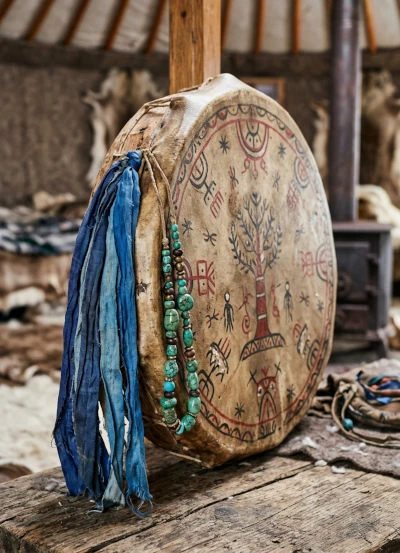 The Inherited Drum
My vision
Shamanism today, here
I'm often asked whether a practice born in the steppe still makes sense in a city of six hundred thousand people. I believe it does, as long as it isn't turned into a postcard. I don't ask anyone to believe in spirits. I ask for something more modest: to accept, for one hour, not understanding everything.
Shamanism is not a religion; it requires no conversion and competes with no faith. It is a very ancient technique for connecting — with the living, the dead, the landscape, and the parts of ourselves left behind along the way. It works through the body, rhythm and attention, not through belief.